Hill
Description
The Hill equation is a parametric dose-response model derived from chemical kinetics. It has a sigmoidal shape when plotting against log-scaled doses. It contains the following parameters
Parameter |
Description |
|---|---|
|
Effect when \(d=0\) |
|
Asymptotic effect as \(d \rightarrow \infty\) |
|
Dose such that \(E(d=C) = \frac{E_0 + E_\text{max}}{2}\) |
|
“Hill coefficient” related to the slope near \(d=C\) |
There are two public subclasses of synergy.single.hill.Hill
Hill_2PThis model does not fit
E0orEmax, but rather expects them to be supplied when the model is instantiated.
Hill_CIThis model is a further subclass of
Hill_2PwithE0=1.0andEmax=0.0. Additionally, it fits the dose-response curve using the linearization method of the median effect equation, rather than viascipy.optimize.curve_fit().
Assumptions
The data should follow a sigmoidal shape
If the assumptions are not met, you may consider using a different single-drug model, such as LogLinear.
Hill Example
Fit the model to data
Dose response models work with 1D arrays of E and drug dose.
Specifying parameter bounds
When reasonable bounds on parameters are known, these bounds can be passed into the model. If you struggle to get good fits, constraining parameters into reasonable ranges can often help.
There are a few ways to do this
Pass bounds for specific parameters:
Hill(E0_bounds=(0.9, 1), h_bounds=(0.5, 2), ....Pass “generic” bounds for
E:Hill(E_bounds=(0, 1), h_bounds=(1e-3, 1e3).With generic bounds, both
E0andEmaxwill be constrained by the given bounds,
Mix the above:
Hill(E_bounds=(0, 1), E0_bounds=(0.9, 1), ...).Specific bounds will always take priority of generic bounds, so this would use
(0.9, 1)forE0, and(0, 1)forEmax.
By default, Hill uses bounds of (0, inf) for h and C, and (-inf, inf) for E parameters.
For this synthetic dataset, the data was generated such that E ranges from 0 to 1 (+/- noise, but we can assume all E params should be in that range). So we can pass E_bounds=(0, 1) when we instatiate the model.
[1]:
import numpy as np

from synergy import datasets
from synergy.single import Hill

np.random.seed(1234)  # deterministic confidence intervals

d, E = datasets.load_hill_example()
model = Hill(E_bounds=(-0.1, 1.1))
model.fit(d, E, bootstrap_iterations=100)  # bootstrap_iterations is used to estimate confidence intervals
Plot the model fit
[2]:
from matplotlib import pyplot as plt

from synergy.utils import remove_zeros

fig = plt.figure(figsize=(5, 4))
ax = fig.add_subplot(1, 1, 1)
ax.scatter(remove_zeros(d, num_dilutions=2), E)

# This is used as the x-axis values for model.E(d), to give a smooth curve
d_smooth = np.logspace(-2, 2)
ax.plot(d_smooth, model.E(d_smooth))
ax.set_xscale("log")
ax.set_xlabel("Dose")
ax.set_ylabel("Effect")
ax.set_title("Hill.E(d)")
plt.show()
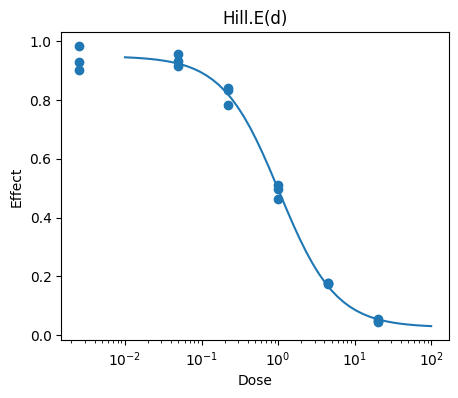
Check model fit quality
All parametric models automatically calculate quality-of-fit scores.
[3]:
print(f"Is fit: {model.is_fit}")  # True if model.fit() was run
print(f"Fit converged: {model.is_converged}")  # True if the model fit successfully converged
print(f"Is fully specified: {model.is_specified}")  # True if all parameters are set (required to call model.E())
print()
print("Fit Quality Stats")
print(f"  Sum of squares residuals: {model.sum_of_squares_residuals}")
print(f"  R^2: {model.r_squared}")
print(f"  AIC: {model.aic}")
print(f"  BIC: {model.bic}")
Is fit: True
Fit converged: True
Is fully specified: True

Fit Quality Stats
  Sum of squares residuals: 0.008834185033397293
  R^2: 0.996153655058854
  AIC: -124.07404413296418
  BIC: -122.69910842040643
Get all model parameters and confidence intervals
[4]:
print("Parameters")
print(model.get_parameters())
print()

print("Confidence Interval (95%)")
print(model.get_confidence_intervals())
print()

print("Confidence Interval (50%)")
print(model.get_confidence_intervals(confidence_interval=50))
print()
Parameters
{'E0': 0.9486656324539504, 'Emax': 0.02687061853180388, 'h': 1.1734807393913014, 'C': 1.034970209440454}

Confidence Interval (95%)
{'E0': array([0.92956039, 0.97436566]), 'Emax': array([-0.00384545,  0.06494899]), 'h': array([1.03013288, 1.35836766]), 'C': array([0.92052359, 1.16038919])}

Confidence Interval (50%)
{'E0': array([0.94089162, 0.95468789]), 'Emax': array([0.0181467 , 0.04309284]), 'h': array([1.12620809, 1.2573561 ]), 'C': array([0.98274748, 1.07777016])}
Hill_2P Example
[5]:
from synergy.single import Hill_2P

np.random.seed(1234)  # deterministic confidence intervals

d, E = datasets.load_hill_example()
model_2p = Hill_2P(E0=1.0, Emax=0.0)
model_2p.fit(d, E, bootstrap_iterations=100)
Plot and analyze Hill_2P fit
[6]:
fig = plt.figure(figsize=(5, 4))
ax = fig.add_subplot(1, 1, 1)
ax.scatter(remove_zeros(d, num_dilutions=2), E)

# This is used as the x-axis values for model.E(d), to give a smooth curve
d_smooth = np.logspace(-2, 2)
ax.plot(d_smooth, model_2p.E(d_smooth))
ax.set_xscale("log")
ax.set_xlabel("Dose")
ax.set_ylabel("Effect")
ax.set_title("Hill_2P.E(d)")
plt.show()

print("\n===\n")
print("Model Fit Scores")

print(f"Is fit: {model_2p.is_fit}")  # True if model.fit() was run
print(f"Fit converged: {model_2p.is_converged}")  # True if the model fit successfully converged
print(f"Is fully specified: {model_2p.is_specified}")  # True if all parameters are set (required to call model.E())
print()
print("Fit Quality Stats")
print(f"  Sum of squares residuals: {model_2p.sum_of_squares_residuals}")
print(f"  R^2: {model_2p.r_squared}")
print(f"  AIC: {model_2p.aic}")
print(f"  BIC: {model_2p.bic}")

print("\n===\n")
print("Model Parameters")

print("Parameters")
print(model_2p.get_parameters())
print()

print("Confidence Interval (95%)")
print(model_2p.get_confidence_intervals())
print()

print("Confidence Interval (50%)")
print(model_2p.get_confidence_intervals(confidence_interval=50))
print()

===

Model Fit Scores
Is fit: True
Fit converged: True
Is fully specified: True

Fit Quality Stats
  Sum of squares residuals: 0.02024364996923748
  R^2: 0.9911860505122833
  AIC: -115.42514573683924
  BIC: -113.55403046315075

===

Model Parameters
Parameters
{'h': 0.9954835060681304, 'C': 0.9678777475974989}

Confidence Interval (95%)
{'h': array([0.90821956, 1.11325105]), 'C': array([0.87306605, 1.0633984 ])}

Confidence Interval (50%)
{'h': array([0.95776381, 1.04535511]), 'C': array([0.93218408, 1.01349353])}
Hill_CI Example
[7]:
from synergy.single import Hill_CI

d, E = datasets.load_hill_example()
model_ci = Hill_CI()  # parameter bounds are not yet supported for Hill_CI
model_ci.fit(d, E)  # confidence intervals are not yet supported for Hill_CI
Plot and analyze Hill_CI fit
[8]:
fig = plt.figure(figsize=(5, 4))
ax = fig.add_subplot(1, 1, 1)
ax.scatter(remove_zeros(d, num_dilutions=2), E)

# This is used as the x-axis values for model.E(d), to give a smooth curve
d_smooth = np.logspace(-2, 2)
ax.plot(d_smooth, model_ci.E(d_smooth))
ax.set_xscale("log")
ax.set_xlabel("Dose")
ax.set_ylabel("Effect")
ax.set_title("Hill_CI.E(d)")
plt.show()

print("\n===\n")
print("Model Fit Scores")

print(f"Is fit: {model_ci.is_fit}")  # True if model.fit() was run
print(f"Fit converged: {model_ci.is_converged}")  # True if the model fit successfully converged
print(f"Is fully specified: {model_ci.is_specified}")  # True if all parameters are set (required to call model.E())
print()
print("Fit Quality Stats")
print(f"  Sum of squares residuals: {model_ci.sum_of_squares_residuals}")
print(f"  R^2: {model_ci.r_squared}")
print(f"  AIC: {model_ci.aic}")
print(f"  BIC: {model_ci.bic}")

print("\n===\n")
print("Model Parameters")

print("Parameters")
print(model_ci.get_parameters())
print()

===

Model Fit Scores
Is fit: True
Fit converged: True
Is fully specified: True

Fit Quality Stats
  Sum of squares residuals: 0.02105340328571227
  R^2: 0.9908334893466948
  AIC: -114.71916664367039
  BIC: -112.8480513699819

===

Model Parameters
Parameters
{'h': 0.9627465059253871, 'C': 0.9361750189247218}
References
Chou, Ting‐Chao, and Paul TaLaLay. “Generalized equations for the analysis of inhibitions of Michaelis‐Menten and higher‐order kinetic systems with two or more mutually exclusive and nonexclusive inhibitors.” European journal of biochemistry 115.1 (1981): 207-216.
[ ]: